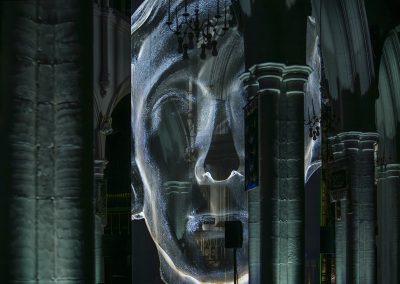
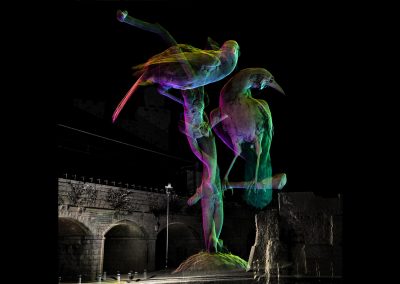
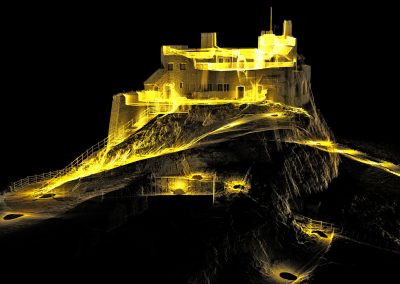
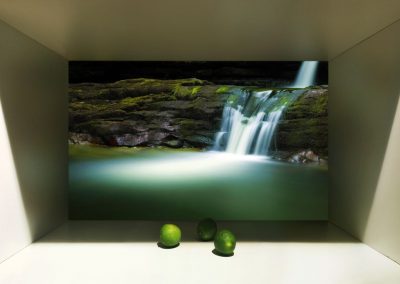
Large-scale architectural projection event commissioned by Hull Time Based Arts, 1996.
Created for three UK sites: Hull, Warehouse 6, October 1996. Sheffield, Owen Building, Sheffield Hallam University, November 1996. Southampton, Guildhall, December 1996.
Float was devised as a nocturnal architecture constructed from light and illusion which could be applied to facades using projection. Like any other building material, light and illusion have their own inherent tectonic and physical properties. The imagery within the projections explored the qualities of these properties and the contradiction of building with such ephemeral materials.
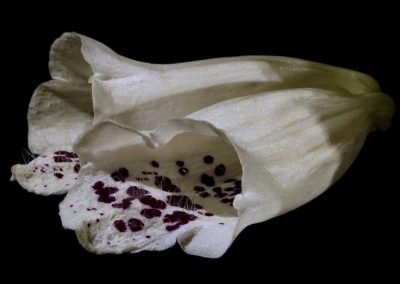
Float was created using three projected elements, designed to engage the viewer at different points around the building. The first element was an architectural illusion, projected at scale, which had the power to draw an audience towards the building. As people moved closer to the facade, a thermographic camera located within the building detected the heat patterns of bodies and movements. This camera was linked to a data projector which projected these live images back onto the building. The third projected element involved a smaller projection of a material surface that was constantly evolving. This only became visible at proximity to the building.
The large projections were created specifically for each of the three city sites, whilst the conceptual approach and other projected elements remained the same.
Process for making Float: A series of scale architectural models were developed for each site and photographed with a 10 x 8 tilt and shift plate camera. This process gave us the control to key in precisely with each architectural facade, create multiple exposures and correct any keystone effect.